Healthcare Operations · Patient Experience
What Happens When Healthcare Becomes Transactional?
I think healthcare has slowly become more transactional. I don't necessarily mean that healthcare organizations want it to be that way. I don't think most people working in healthcare wake up thinking about how they can make a patient's experience less personal. I think a lot of it is the result of the environment healthcare organizations are operating in.
When Efficiency Becomes the Goal
Healthcare is expensive. Labor costs continue to rise. Supplies cost more. Demand for healthcare services continues to increase. At the same time, reimbursement doesn't always increase at the same rate as the cost of providing care. Organizations are being asked to do more while operating with tighter margins, so naturally they start looking for ways to become more efficient and reduce costs.
I understand that. I've worked in healthcare operations, and I understand why organizations look at a process and ask whether it can be done differently. If a revenue cycle function can be performed for less money by an offshore team, I understand why an organization would consider it. If technology can handle a repetitive administrative process, I understand why we use it. There is a tremendous amount of work in healthcare that doesn't necessarily require a person sitting there doing the same thing over and over again. Scheduling, insurance verification, billing, coding and documentation are all areas where technology and automation can make a lot of sense.
What the Patient Actually Experiences
The problem is that the organization sees a process, while the patient experiences the interaction.
A patient doesn't necessarily know that the person handling their billing question may work for an outside company. They don't know that the person answering the phone may be part of a centralized team supporting multiple locations. They don't know why they have to explain their situation again or why the person they're talking to doesn't seem to understand what happened during their visit. They just know that they called their healthcare organization and didn't feel like they were talking to someone who understood them.
That can create distance. And I think over time, that distance can affect trust.
Technology Isn't the Problem
The same thing can happen with technology. I think AI has a place in healthcare. I actually think there are a lot of things we should be using it for. It can help with scheduling, billing, coding, documentation, insurance verification and establishing protocols around the reason for a visit. It can reduce administrative work and potentially give healthcare employees more time to actually spend with patients.
But I have a harder time when that technology becomes the interaction with the patient.
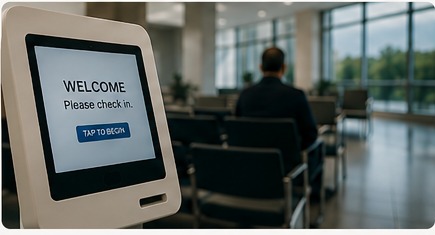
Think about what it takes for someone to get to a healthcare appointment. They may have taken time off work, found childcare, driven to a clinic or rearranged their day for a telehealth visit. They finally get to the point where they're going to talk to someone about their health, and instead of having that initial conversation with another person, they're asked to explain their reason for the visit to an AI assistant.
I understand why that is attractive from an operational standpoint. The information can be gathered quickly, organized and passed along to the clinician. It can save time. But the conversation itself has value too.
A patient may say something that causes a nurse or medical assistant to ask another question. They may hesitate when talking about something. They may explain something differently to another person than they would to a computer. Sometimes the reason a patient gives for the visit isn't really what is bothering them the most. Those things aren't always captured by simply collecting information.
And that's where I think we need to be careful.
Not every interaction that takes time is waste.
A conversation takes time. Listening takes time. Building trust takes time. Those things don't always show up on a financial statement, and they're not necessarily going to improve a productivity metric. But they're still part of the healthcare experience.
I don't think healthcare has to choose between being efficient and being personal. There are plenty of things in healthcare that should be automated, centralized or redesigned. There are costs that need to come down. There are processes that could be much better. I don't disagree with any of that.
I just think we need to remember what we're trying to make more efficient.
If we use technology to remove administrative work so a nurse has more time with a patient, that's a good thing. If we use it to make it easier for a clinician to document a visit so they can spend more time talking to the patient, that's a good thing. If an offshore team can handle certain work without creating problems for the patient, then I understand why an organization would use one.
But if the pursuit of efficiency means that a patient has fewer opportunities to actually interact with someone who knows their situation, I think we should stop and think about what we're gaining and what we're giving up.
Because the patient doesn't experience our organizational structure. They don't see our margins. They don't see our staffing models or our reimbursement challenges. They experience the person who answers the phone, the person who checks them in, the person who takes their history and the person who sits across from them and listens.
Those interactions may look like costs to the organization.
To the patient, they may be the part that makes healthcare feel like care.
Where Do We Draw the Line?
I don't think we need to stop using technology, outsourcing work or looking for ways to control costs. We can't ignore the financial reality of healthcare. But I do think we need to be more thoughtful about where we draw the line.
There are a lot of things in healthcare that could be more efficient.
The relationship between the patient and the people caring for them probably isn't one of them.


Loading comments...